
Thai fighting Betta fish are of great interest to many fish keepers in Vietnam because Thailand has a long history of raising and selectively breeding Betta fish. However, when buying fish online, just because a fish is introduced as “Thai Betta” does not mean that the buyer can immediately determine that it is actually imported from Thailand.
After many years of directly raising and selecting fish, I find that identifying Thai fighting Betta fish should not be based only on color or external appearance. The most important things are still the fish’s origin, the seller’s information, and the actual quality of each individual fish.
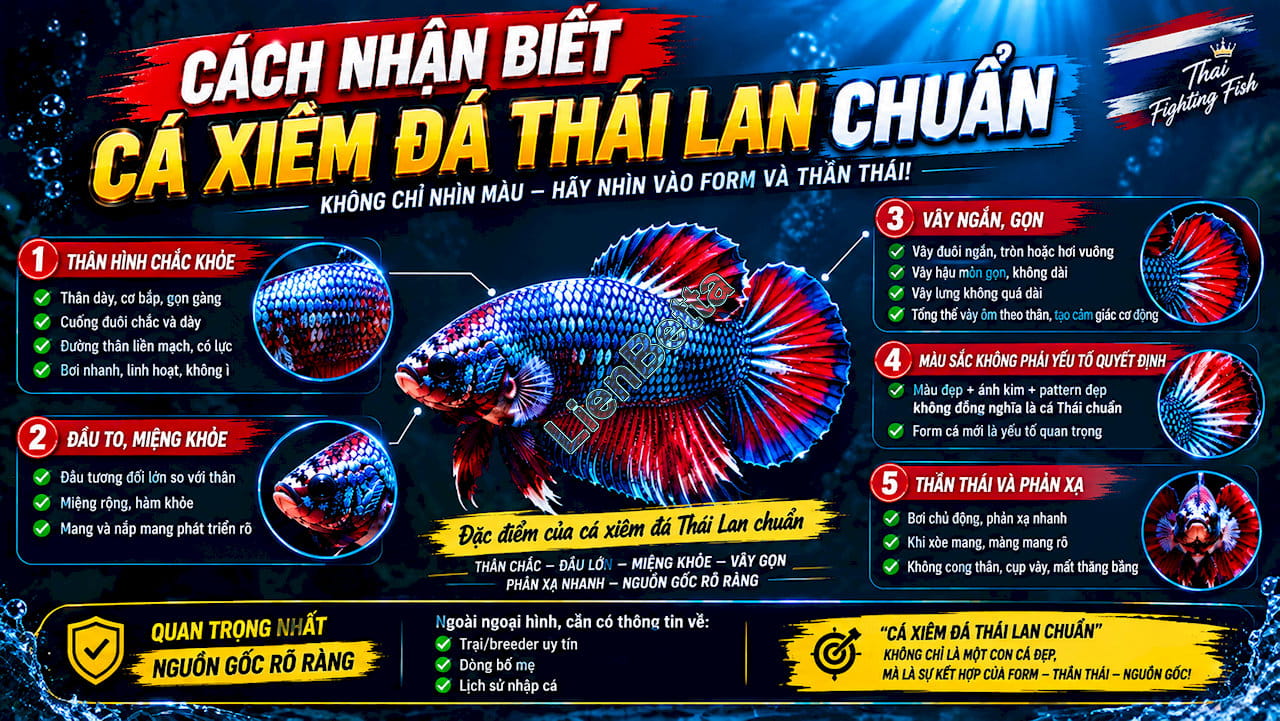
What Are the Characteristics of Thai Fighting Betta Fish?
Thai fighting Betta fish do not have one fixed color or body shape. They can have many different colors, sizes, and body forms depending on the strain and the selection methods of each farm.
Therefore, there is no single physical characteristic that can be used to confirm 100% that a fish is from Thailand.
A fish raised in Vietnam can completely have a color or form similar to a Thai fish. On the other hand, fish imported from Thailand can also have different levels of quality.
Based on my experience, when buying Thai fish, I usually consider the origin first and then evaluate the quality of the fish.
1. Check the Fish’s Origin
This is the most important factor if you want to buy authentic Thai fighting Betta fish.
The seller should have relatively clear information about the fish’s source, such as whether the fish was imported from Thailand, which farm it came from, or which supplier it was sourced through.
If possible, you should ask:
- Which farm does the fish come from?
- Is the fish imported directly or through an intermediary?
- What strain does the fish belong to?
- Are there actual photos or videos of the fish?
Not every seller can provide complete information about the farm in Thailand, but at the very least, the origin should be clearly explained.
If the only information is “selected Thai fish” or “VIP Thai fish” without any additional information about the fish’s source, I would not use these names to determine whether the fish is actually from Thailand.
2. Look at the Fish’s Body Shape and Form
After checking the origin, I will look directly at the fish itself.
A healthy fish usually has a balanced body shape, swims normally, and does not show any obvious abnormal signs.
When looking at the fish, you should pay attention to:
- Is the body well-proportioned?
- Is the back abnormally curved?
- Are the head and body well-balanced?
- Are the fins and tail badly torn?
- Is the fish too thin or does it have an unusual belly?
- Does the fish swim actively?
However, remember that a beautiful form does not mean that the fish is definitely Thai.
This is a way to evaluate the quality of the fish, not a way to determine its country of origin.
3. Observe the Color but Do Not Use Color to Determine the Origin
Thai fighting Betta fish can have many different colors and patterns.
A fish with beautiful colors, good coloration, or an attractive form may immediately make the buyer think that it is a Thai fish. But in reality, these characteristics can also appear in fish raised in Vietnam, Indonesia, or Cambodia.
Therefore, I only consider color to be one criterion for choosing a fish, not evidence proving its origin.
If a seller says a fish is Thai simply because it has a beautiful color or form, you should look into other information as well.
4. Watch a Video of the Actual Fish
If I buy Thai fighting Betta fish online, I prefer watching a video rather than only looking at photos.
A video allows you to observe:
- Swimming behavior.
- The fish’s reaction.
- The condition of the fins.
- The actual size.
- Color under different lighting conditions.
- The overall condition of the fish.
In particular, you should prioritize a video of the exact fish being sold, rather than just watching a sample video of the entire fish strain.
A beautiful photo can show the color and form, but it cannot fully show the fish’s condition at the time of purchase.
5. Do Not Use Price to Determine Whether a Fish Is Thai
A fairly common belief is that an authentic Thai fish must definitely have a high price.
In reality, that is not necessarily the case.
The price of a fish also depends on its strain, size, color, form, level of selection, supplying farm, and transportation costs.
A common Thai fish may have a reasonable price, while a carefully selected fish can cost much more.
Therefore:
A high price does not prove that a fish is Thai.
On the other hand, a low-priced fish does not necessarily mean that it is not Thai.
6. A Reputable Seller Is More Important Than Advertising Claims
When buying fish online, I usually pay as much attention to the seller as I do to the fish itself.
A shop or fish farm with a clear sales history, regularly updated photos and videos of actual fish, and specific advice will make it easier for buyers to check the source of the fish.
You can look at:
- Actual photos of the fish at different times.
- Videos of the fish before shipping.
- Information about the farm or fish source.
- Customer feedback.
- How the fish is packaged and shipped.
In particular, if the seller is willing to let customers see actual photos or videos before purchasing, it will be easier for the buyer to evaluate the fish.

Things That Cannot Be Used to Confirm a Fish Is Thai
There are some characteristics that are often misunderstood as signs for identifying Thai fighting Betta fish.
Beautiful color: does not prove Thai origin.
Beautiful form: does not prove Thai origin.
Strong reaction from the fish: does not prove Thai origin.
High price: does not prove Thai origin.
The seller calling it a Thai fish: is also not enough to confirm its origin.
The origin should be considered based on information about where the fish was raised, its source, and the seller, rather than trying to find a “special sign” on the fish’s body.
Should You Buy Thai Fighting Betta Fish?
Based on my experience, Thai fighting Betta fish are worth considering if you like imported fish and want to collect fish strains from Thai farms.
However, you should not think that Thai fish are always better than Vietnamese fish.
When buying, I still prioritize:
Healthy fish → clear origin → beautiful form → the right strain for me → reasonable price.
If a Thai fish has a clear origin, is healthy, and is suitable for the amount of money you are spending, then it is worth buying.
But if there is only the label “Thai fish” without clear information about the fish’s source, I would consider it more carefully.
My Experience in Choosing Thai Fighting Betta Fish
If you are preparing to buy Thai fighting Betta fish, you can quickly check them through these 5 steps:
1. Ask about the origin: Where was the fish imported from, and what is the source?
2. See the actual fish: Prioritize photos and videos of the exact fish being sold.
3. Check the health: Eyes, body, fins, tail, and swimming behavior.
4. Do not judge only by color or price: These are not evidence for determining the origin.
5. Choose a transparent seller: The clearer the information about the fish and its source, the easier it is to make a purchase.
Conclusion
The way to identify authentic Thai fighting Betta fish does not lie in a specific color, body form, or price.
The most important thing is to check the fish’s origin, combined with evaluating the health, form, color, and actual quality of each individual fish.
Based on my experience at Ngoc Lien Aquarium Fish - LienBetta.Com, when buying imported fish, do not only ask “Is this a Thai fish?” but also ask “Where does the fish come from, and what is the actual condition of the fish?”.
That is the way to help me choose a fighting Betta that is suitable and worth the money I spend.


 Vietnamese
 English